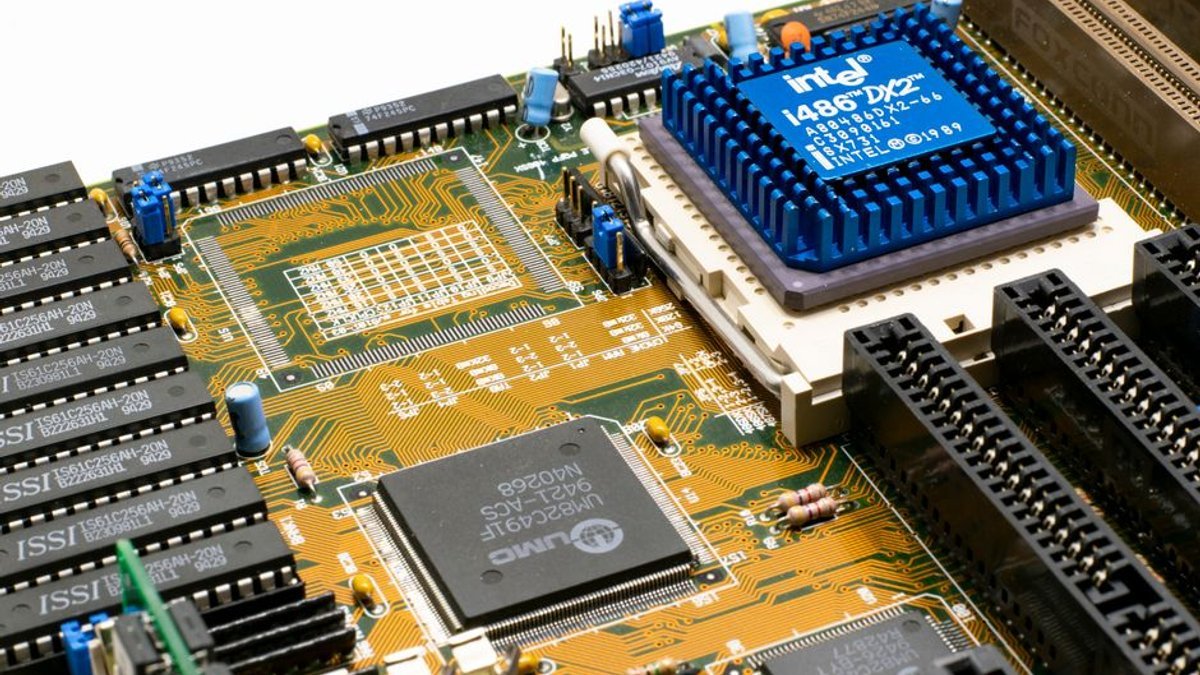
The Intel 8087 floating-point coprocessor, launched in 1980 alongside the 8086, has long been celebrated as a marvel of microarchitecture. For years, engineers assumed its transcendental functions relied on CORDIC (Coordinate Rotation Digital Computer) alone. A new reverse-engineering effort has upended that assumption, revealing that the tangent algorithm is a hybrid: CORDIC handles part of the computation, while a polynomial approximation finishes the job.
Why the 8087 Still Matters
The 8087 was not a niche curiosity. It shipped with roughly 45,000 transistors and could execute floating-point operations up to 100 times faster than the 8086 alone, according to contemporaneous Intel documentation. That performance jump made it indispensable for CAD, scientific computing, and early spreadsheets. Its instruction set also seeded the x87 architecture that persisted in x86 processors for decades.
Understanding how the 8087 computed tangents is therefore more than historical trivia. It illuminates the trade-offs chip designers faced when silicon area, power, and precision were all tightly constrained. The hybrid approach suggests Intel's engineers were willing to mix algorithmic families to hit accuracy targets without inflating the die.
The Hybrid Algorithm Explained
CORDIC is elegant for rotations and trigonometric work because it uses only shifts and additions. But CORDIC has known limitations near certain angle ranges, where convergence slows or precision suffers. The reverse-engineering findings indicate the 8087 switched to polynomial approximation in those regions, effectively patching CORDIC's weak spots with a numerically tailored fallback.
This is not a trivial detail. It implies the 8087's microcode contained branching logic that selected between computational paths based on the input angle. That kind of adaptive execution was sophisticated for 1980-era silicon, and it foreshadows techniques now common in modern FPUs and AI accelerators.
What It Means for Computing Today
The discovery resonates because hybrid numeric methods are back in vogue. GPUs and tensor processors juggle multiple approximation strategies to balance throughput and accuracy. Seeing the same philosophy in a 1980 coprocessor is a reminder that good engineering ideas tend to resurface when constraints tighten.
For retrocomputing enthusiasts and chip historians, the finding also opens new avenues: other 8087 functions may hide similar hybrids. Expect further teardowns to test that hypothesis, and watch how these insights inform emulator accuracy and modern low-precision math libraries.


Comments
No comments yet.